
India’s Bitchat takedown and the tools they don’t want you to use
No mesh for you
The name they chose was prescient: India’s Cockroaches have outlasted a sustained meltdown among India’s political elite, forcing the resignation of the Minister of Education and striking at least one electoral blow against the ruling party. Tens of thousands took part the in the youth protests, which began online but swelled to dramatic proportions in the streets of New Delhi. People everywhere are tired of their futures being held hostage by people who call them bugs.
The marches were punctuated with pretty horrific police brutality, and at least one internet shutdown. In its last flailing strike against the protests Indian authorities sent a notice to GitHub, demanding that the peer-to-peer messaging app Bitchat be taken down.
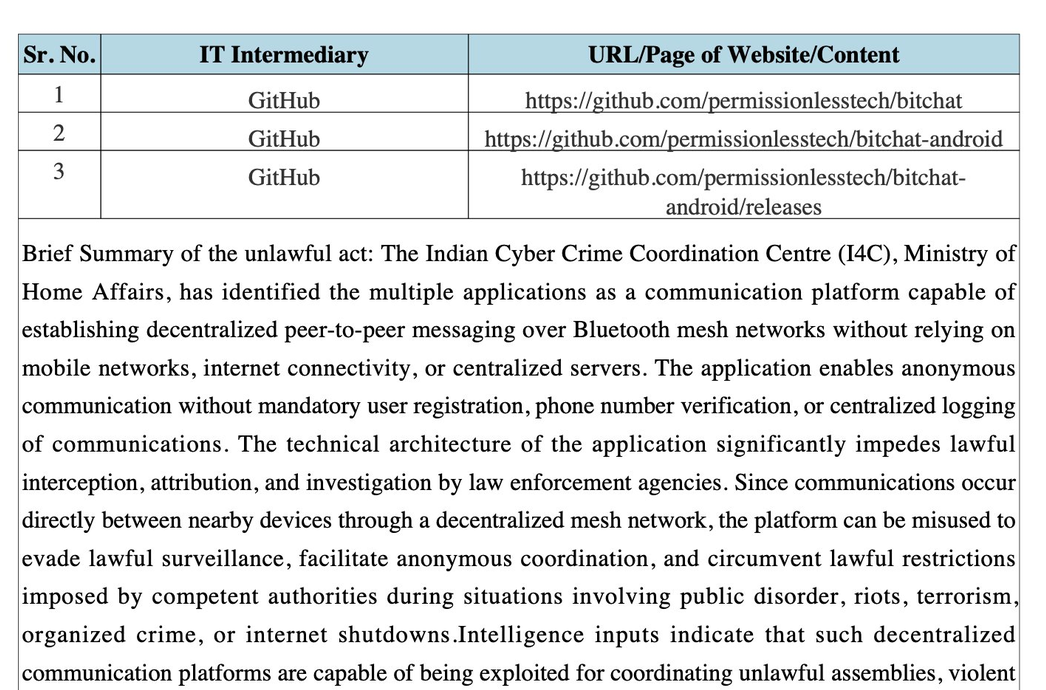
This is only the most recent volley in India’s war against digital organizing. In 2023 Wired published a piece titled “India’s Government Wants Total Control of the Internet,” and things haven’t improved since. According to Access Now, in 2025 India shut down the internet at least 65 times, the most of any country after Myanmar (whose border with India is intensely policed). The Indian government has placed bans on VPNs. And it constantly orders the takedown of anti-government speech, even the most anodyne, using rules similar to the U.S.’s proposed Kids Online Safety Act to make uncooperative companies legally liable for the content they host.
The attack on Bitchat is a new extreme. The Home Industry describes Bitchat’s underlying technology itself as subversive, because peer-to-peer communications can evade surveillance (or, as they call it, “lawful interception”). This is very different from censoring out a YouTuber or a hashtag; it’s marking the application’s design verboten. I struggle to produce an appropriate analogy, but it’s a bit like going after not the Taylor Farms lettuce, but the technology of the burrito.
Why is Bitchat so threatening to the Indian government? The simple answer is that it’s decentralized, and so it’s resilient—it’s difficult to control with the usual methods (blanket telecom outages, site blocks). The mesh network that backs Bitchat means it’s not especially useful over large distances, but it is an effective way to connect people in small hyperlocal bursts. Bitchat would have enabled, for instance, comms to remain open when BART shut down underground wireless access in 2011, or when a mysterious something blocked cell signals at a #NoDAPL standoff in 2016.
The connections that peer-to-peer messengers fosters are, by nature, transitory and reactive; a mesh only meshes when people and their radio-emitting devices are active and close together. So, the system is a shapeshifter: it’s not threatening to governments in peaceful areas with low densities of people (chances are high there’s no one on Bitchat in your neighborhood right now; chances are police aren’t too concerned about it), but it can quickly turn problematic for governments when shit hits the fan.
This time, the protests ended before the Bitchat takedown order shook out: we don’t know if Microsoft would have pulled Bitchat from GitHub, or if other apps would have been targeted under the same logic. But the attempt shows that governments are very serious about controlling how we use our stuff: we each have phones with computational power that could get us to the moon many times over, but god forbid you install a boutique operating system. Or actually open it up to see what’s inside.
“Unorthodox” apps and operating systems are threatening to leaders in the U.S., too. The Trump administration is trying out all sorts of ways to mark particular technology use as potentially terroristic. We’re seeing one rendition in the charges against Samuel Tunick, the Atlantan and Stop Cop City activist who deployed a safety feature of Graphene OS that allowed him to wipe his phone. Other lockdowns are coming from the tech monopolies that depend on the feds’ benevolence: like Google’s planned quarantine of its app store, which would create a bottleneck like Apple uses to, for instance, block downloads of Telegram in certain places.
We can understand why Trump might want to enable Modi-style internet lockdowns. But lawmakers who swear they have good intentions are tripping over themselves to pass age verification bills and the Kids Online Safety Act (KOSA)—which are really two pathways towards making censorship and surveillance inescapable on the internet.
Age verification, which is !impossible to perform safely and privately!, makes certain uses of your device contingent on providing a face scan or a government ID. KOSA would flag certain government-prescribed topics as “harmful to youth,” thus extremely costly and then impossible for platforms to host.
Both of these attacks on privacy and anonymity online are framed as “protecting the kids”; note too that the putative reason for searching Tunick’s phone was a search for CSAM. When the same justification is used to propose bans on strong encryption, it’s not hard to imagine a world where restrictions on peer-to-peer communication apps are next.
But there were “kids” participating in the Stop Cop City protests. There were “kids” marching with the Cockroaches in New Delhi. There are “kids” protesting ICE abductions and raising money for ICE victims’ families. Before blocking the tools that let people stay resilient amid government crackdowns; would it be so terribly difficult for lawmakers to consider these kids, too?
Readout
- Download Bitchat here: https://bitchat.free/
- Fight Android lockdowns here: https://keepandroidopen.org/
- Atlanta is the most heavily surveilled city in the United States. A walking tour: https://www.newyorker.com/magazine/2026/08/17/i-spy-with-my-little-eye-a-spy
- No ALPRs Week of Action is coming up: https://noalprs.com/
- The organizers resisting data centers on Native land: https://organizingmythoughts.org/you-cant-drink-data-native-communities-are-resisting-the-ai-death-cycle/
- 404’s reporting on the Tunick case: https://www.404media.co/the-government-hopes-to-set-a-precedent-an-interview-with-the-man-charged-for-allegedly-wiping-his-grapheneos-phone/
- With advice on how to protect your data: https://unicornriot.ninja/2025/sources-atlanta-activist-arrested-by-fbi-amid-ongoing-targeted-repression-towards-protesters/
Member discussion