
Encrypted messages are hard for AI to swallow

This issue's got an overview of some Meta funny business, some links, and a new portal to the small web.
Meta reneges on encryption
In the early 2020s, Meta made a series of pledges to install default end-to-end encryption on messaging tools across its platforms. This was celebrated, and for good reason: enrolling users in E2EE en masse protects a ton of people from surveillance without asking them to become opsec experts overnight.
Last week, though, we got news that Meta is weaseling its way out of its promises. Instagram, which never actually got default E2EE anyway, will lose the optional feature in on May 8. A spokesperson, blaming users, said no one was using it.
This is an obvious cop out (“no one was using” the bike path, the national park, the postal service). The real reasons Meta is cutting off E2EE are more directly attributable to the company’s core values, reaching all the way back to when Facebook was a tool for anonymously ranking girls’ looks. The company and its leaders are (1) cowards, and (2) losers.
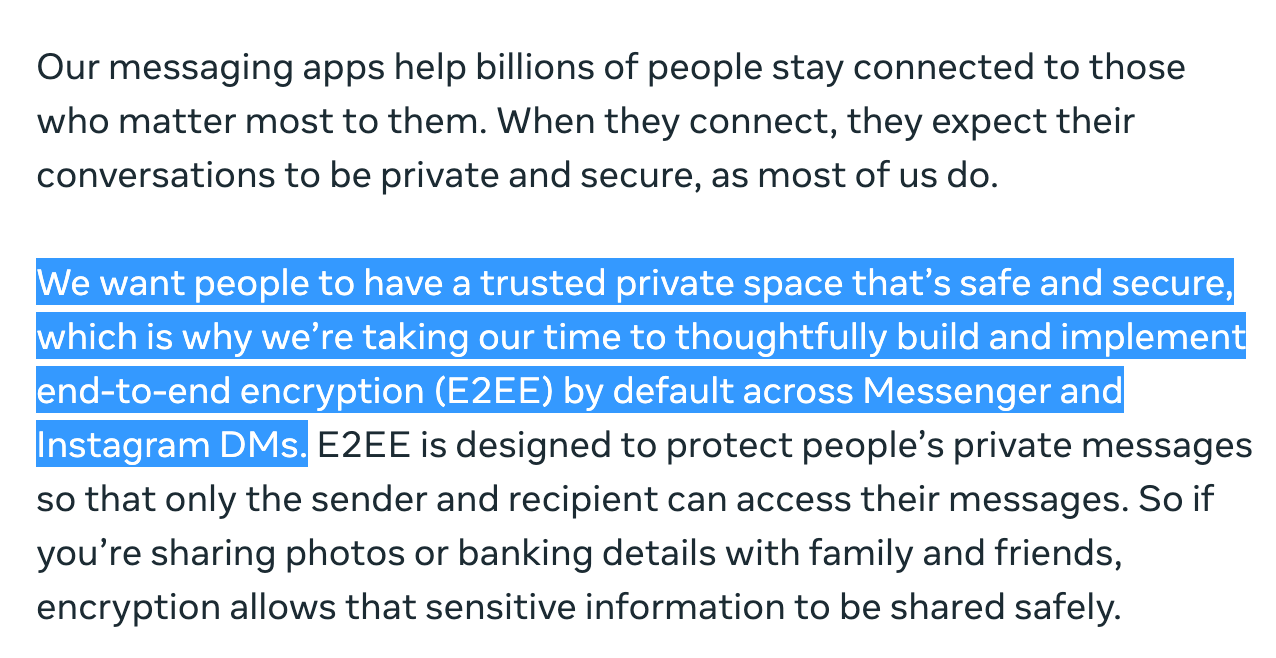
They’re (1) cowards because rolling back E2EE is Meta's signal of submission to authoritarian surveillance states, like the U.S., that demand universal data access and malign encryption as toxic terrorist tech.
They’re (2) losers because it certainly seems like one goal of walking back E2EE is to collect more human-generated material for training Meta’s AI models. Unfortunately, this is likely too little, too late for a company failing rather spectacularly at its AI pivot.
Losing the option to encrypt messages on Instagram sucks. It’s an especially harsh blow to the security-conscious who used Instagram for specific kinds of communication—I’m thinking of groups that provide abortion information to people in a states where it’s criminalized, or journalists who used Instagram to scope out sources. If you want to sign a letter telling Meta to keep Instagram's E2EE alive, go here.
If you want more thoughts on this, keep reading…
Meta’s been in the news for a couple other reasons lately, and I think they’re connected to the backtrack on end-to-end encryption.
First, Meta’s publicly given up on the metaverse, the alternate reality concept that's been the company's namesake since 2021, when Facebook decided to bet it all on legless avatars for Zoom meetings. Second, Meta purchased Moltbook, “the AI agent social network that went viral because of fake posts.” Taken together, these stories are expressive of how Meta, an advertising company, interprets AI.
Advertising constitutes 98% of Meta’s revenue. In order to grow (or, maybe more accurately, to tell a story about growth), the company’s got to locate and exploit new territories in human attention. In the past, this has been accomplished through acquisitions—the purchase of Instagram, for example—updates to its recommendation models, or the launch of shiny new devices.

The very 2025 problem facing the company is that "raw" human attention is providing diminishing returns. Screens and minds have been almost completely colonized with miscellaneous slop—so much so that one of Meta’s projects is to go right to the source and capture our literal eyeballs.
The metaverse solution to this problem was to create (and lock people into) a proprietary virtual world, where the rules of the game could themselves be composed to act as ad tech. People took this effort of Meta's seriously, even though it was pretty ridiculous on its face; that's the narrative bonus awarded to a monopoly in an industry that's propping up the economy.
The AI solution is a little different, but the core concept remains the same. AI is producing a huge, artificial expansion in the quantity of attention available—and it doesn’t particularly matter to Meta that that attention’s bots. If the AI agents spreading all over the web (and increasingly programming Meta’s own tech stack) can access the ad budget or the credit card, that’s close enough to an “impression” to count on investor day.
The problem is that capitalizing on the new artificial attention means keeping your models competitive: both outward-facing models (chatbots, agents) and internal ones (advertising engines like GEM). Meta might be a little nimbler after cutting loose Horizon Worlds (along with hundreds of staff), but it's still not quite on the AI podium.
Getting there takes data. Hence the purchase of Moltbook—it's not just a social media site for bots, it's an "automated synthetic data farm." Hence the slow distancing from end-to-end encrypted messaging—encrypted messages can't train bots. Superintelligence Labs is hungry and it's got to eat.
I will note that we don’t know for a fact that Meta is training its models on your DMs (though it definitely is on any conversations you have with its AI). But if you were an executive tasked with moving Meta up the AI leaderboard, you’d be a fool to cut off access to the data you’re storing on servers anyway. These are proprietary interactions—Altman and Amodei can’t get their hands on them—and mining them isn't an enormous legal risk, like training on the New York Times or the Encyclopedia Britannica.
The core premise behind E2EE is that people deserve private communication, in part because human-to-human relationships should be built on trust. That philosophy is, unfortunately, in direct contradiction to a worldview that sees digital messaging not as a method of communication, but as a style of commodity.
Readout
- Another reason to oppose ALPRs.
- An undercover investigation exposes a rather unique surveillance outfit.
- Nurses in Northern California are striking, in part over a hospital system's attempts to install AI in patient–caregiver relationships.
And the world wide web to explore... do a little wandering.
Member discussion